
The Midwest and the river · Hannibal, Missouri
Hannibal and the river of Tom Sawyer
Samuel Clemens grew up in a river town on the Mississippi and spent the rest of his life writing about it. Hannibal keeps his boyhood home, the hill, the cave and the river.
Hannibal is a river town in northeast Missouri, about a hundred miles north of St. Louis, set between limestone bluffs where the Mississippi runs wide and brown. Samuel Clemens grew up here in the 1840s, and as Mark Twain he went back to it again and again: as St. Petersburg in The Adventures of Tom Sawyer, as the starting point of Adventures of Huckleberry Finn, and in the chapters of Life on the Mississippi that describe his return in 1882. The town has spent more than a century being Twain's town, and some of it is a little worn by that. But the house, the hill, the cave and the river are real, and they are all within a few minutes of one another.
From Florida, Missouri, to the river
Clemens was born on 30 November 1835 in the village of Florida, Missouri, about an hour's drive southwest of Hannibal, where a state historic site keeps the small rented cabin of his birth inside a museum building. In 1839, when he was four, the family moved to Hannibal. His father, John Marshall Clemens, a lawyer and justice of the peace, never prospered, and died in 1847, when Sam was eleven. The boy left school soon after to work as a printer's apprentice.
In 1853, at seventeen, he left Hannibal for jobs in St. Louis, New York and Philadelphia. A few years later he trained as a steamboat pilot on the lower Mississippi and earned his licence in 1859, until the Civil War closed the river to trade in 1861. His pen name comes from the river too: mark twain was the leadsman's call for a depth of two fathoms, safe water for a steamboat.
The boyhood home on Hill Street
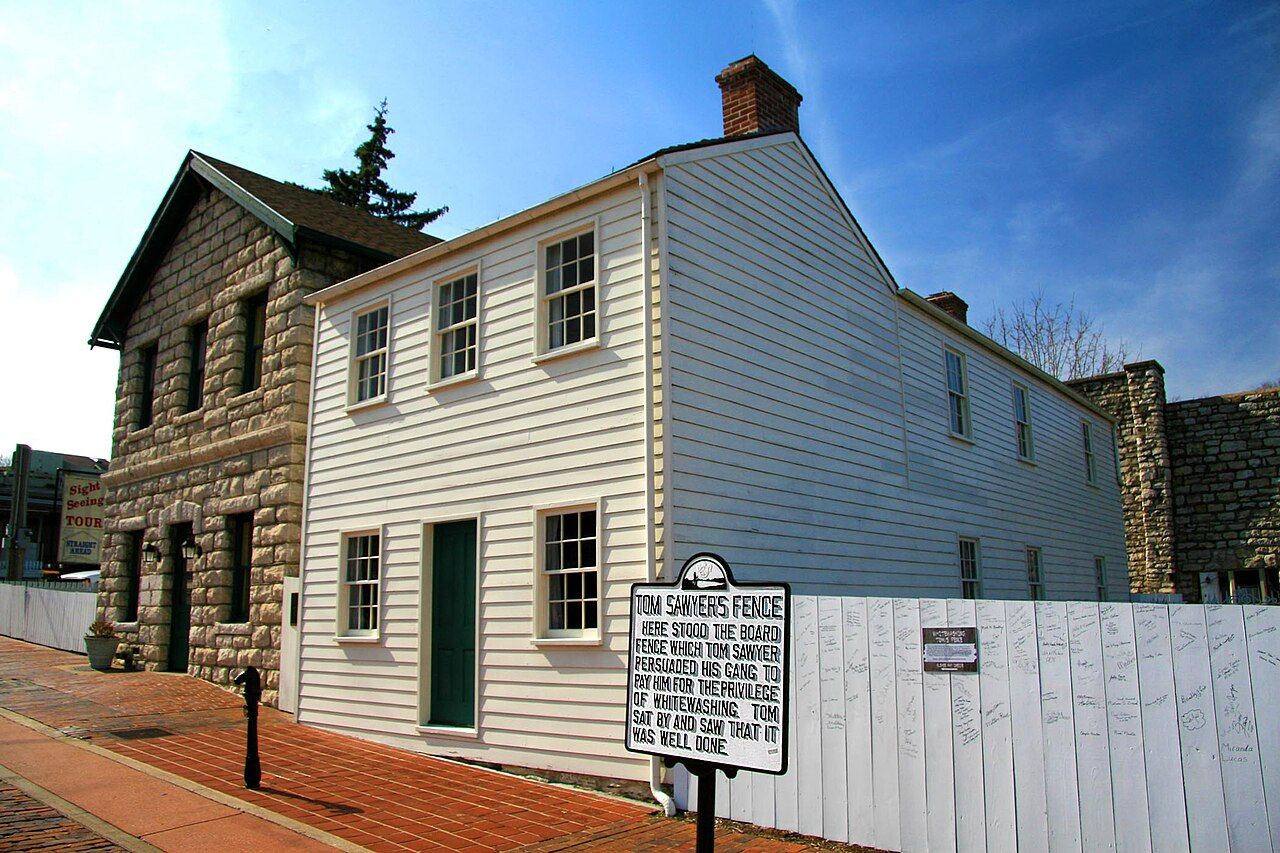
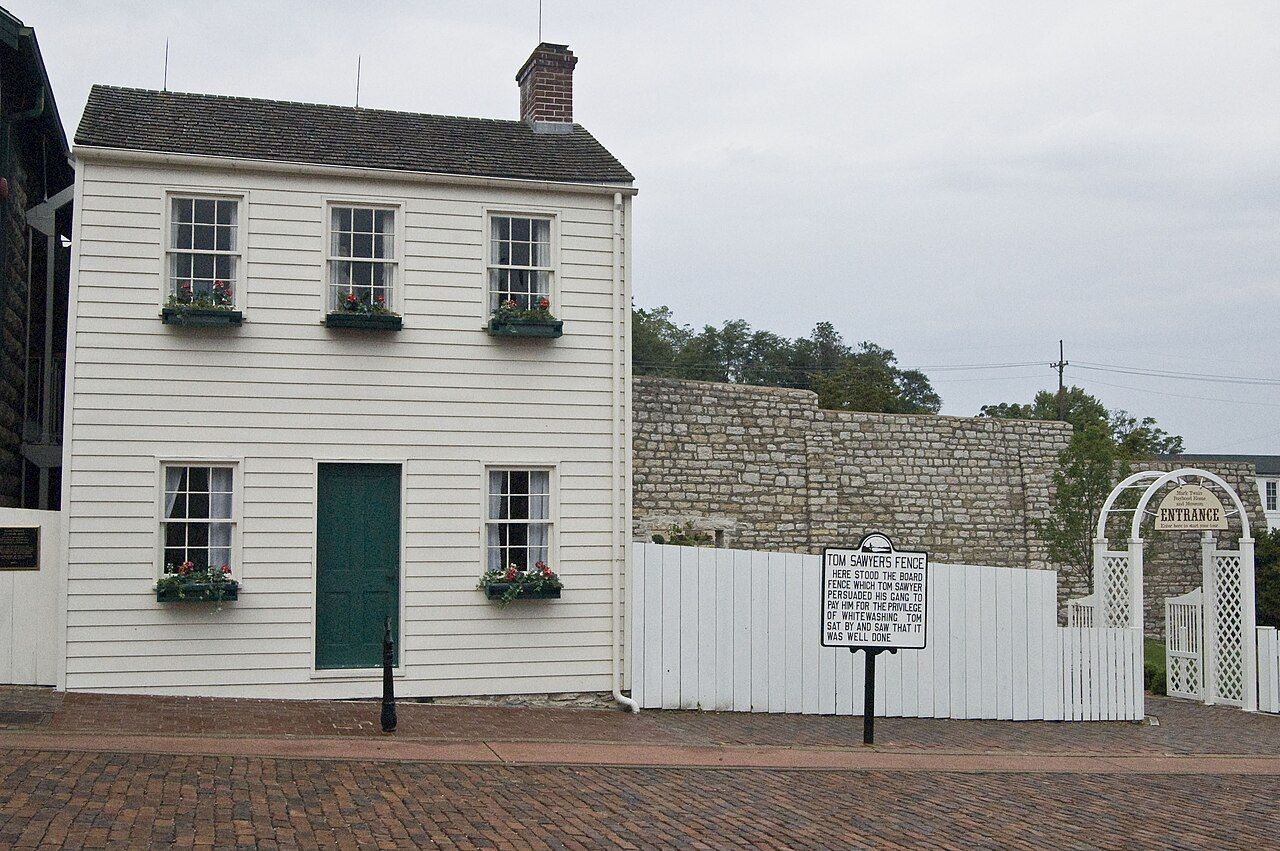
The white two-storey frame house on Hill Street was built by his father in 1844, and the family lived in it until the early 1850s. It is small and plain, and it is the centre of a group of museum buildings run by a non-profit, which you see on a single visit. Beside the house runs a white board fence, the stand-in for the one Tom Sawyer tricks his friends into whitewashing in the second chapter of the novel.
The rooms inside are furnished in the style of the 1840s, and the displays walk you through the family's money troubles, the death of Sam's older brother Benjamin in 1842, and the jobs he took after his father died. It is a modest house for a family that always hoped to be richer, and Twain wrote about that hope, and its disappointments, for the rest of his life.
Across the street is the house where Laura Hawkins lived, the girl usually taken as the model for Becky Thatcher. Nearby is a reconstruction of the house of Tom Blankenship, the son of the town drunk, whom Twain later named as the model for Huck Finn. The museum buildings also include his father's justice of the peace office, and, on Main Street, a gallery with original paintings Norman Rockwell made for illustrated editions of the two novels. Allow at least two hours.
Shelved nearby · MW 077Red Cloud and the prairie Willa Cather carried with herCardiff Hill and the statue
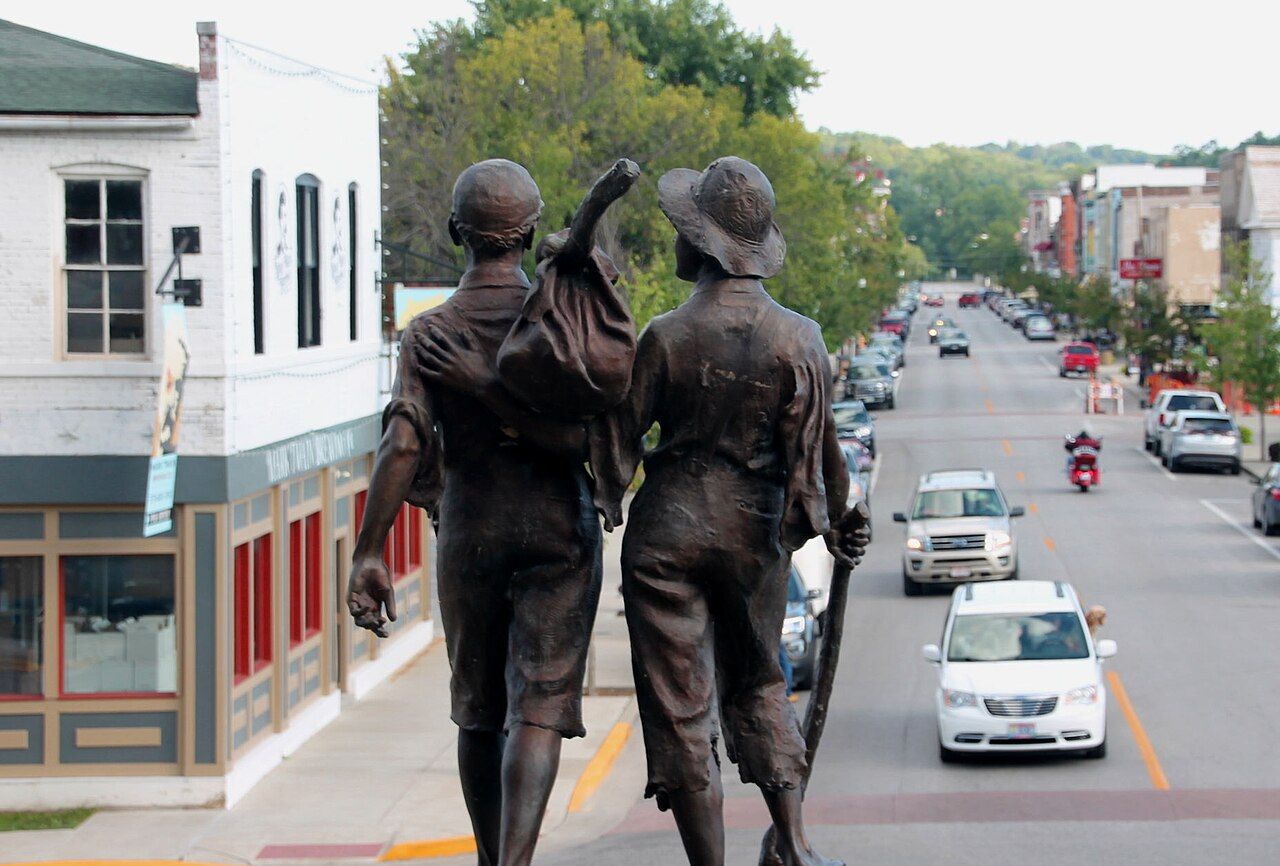
At the north end of Main Street, steps climb the bluff known in the novel as Cardiff Hill; in Twain's day it was Holliday's Hill. At the foot of the hill stands a bronze statue of Tom and Huck, set up in 1926, the two boys with a bundle on a stick, looking out over the town. A small memorial lighthouse was built at the top for the centenary of Twain's birth in 1935, and the climb gives you a long view over the rooftops and up and down the river. On a clear day you can see across to the Illinois shore and the long bridges that carry the highway and the railroad over the water.
The cave
About a mile south of town, a limestone cave runs back into the hills in a maze of narrow passages. In Twain's childhood it was known by the name of the doctor who owned it, and the boys of Hannibal explored it with candles. In Tom Sawyer it becomes McDougal's Cave, where Tom and Becky are lost for days and where Injun Joe dies, sealed in behind a door. Today the cave is privately run and seen on guided tours along lit paths. It stays cool all year, so bring a light jacket even in July.
Slavery in Twain's Hannibal
Missouri was a slave state, and the Hannibal of Twain's childhood was a slaveholding town. His family owned enslaved people at times, and the farm of his uncle, John Quarles, near Florida, where he spent his summers as a boy, was worked by enslaved people; Twain later said that an enslaved man on that farm, known as Uncle Dan'l, was in his mind when he created Jim. In his later writing he described seeing enslaved men chained together in Hannibal, waiting to be shipped down the river for sale. Huckleberry Finn grew out of that world, and it is a book about a boy deciding, against everything he has been taught, to help a man escape. Look for the town's markers and exhibits on its African American history as you walk; they are an essential part of the visit.
The river and Main Street
The Mississippi runs along the east side of the town behind a flood wall built after the great floods of the 1990s. Walk the riverfront in the evening, when the barges push upstream and the light goes gold on the Illinois shore. Excursion boats run short trips in the warmer months. Main Street, a long run of nineteenth-century brick shopfronts, leads back toward the boyhood home. Every year, usually around Independence Day, the town holds National Tom Sawyer Days, with a fence-painting contest and frog-jumping on the street.
In Life on the Mississippi, Twain describes coming back to Hannibal as a famous man in 1882 and finding the town grown and the boys he knew grown old. Read those chapters on the riverfront, looking at the same water. Hannibal is small enough to see on foot: park once near the boyhood home and walk, since the museum buildings, Main Street, the statue and the river are all within a few blocks. Spring and autumn are the most comfortable seasons; midsummer is hot and humid, and the town is busiest around the Fourth of July.
Hannibal sits well on a route up or down the river. Twain's later home in Hartford shows where he wrote the books that made this town famous. Heading south along the river, you reach Faulkner's Oxford in a long day. To the northeast lies Chicago and its libraries.
But the house, the hill, the cave and the river are real, and they are all within a few minutes of one another.
Pictures on loan from
- Bookwritinman CC BY-SA 4.0
- Andrew Balet CC BY-SA 3.0
- Terry Ballard from Merrick, New York, USA CC BY 2.0