
The Midwest and the river · Chicago
Chicago's writers and its library
Chicago built two great public libraries a century apart and raised writers from Theodore Dreiser to Gwendolyn Brooks. Start under a Tiffany dome and end in Hemingway's Oak Park.
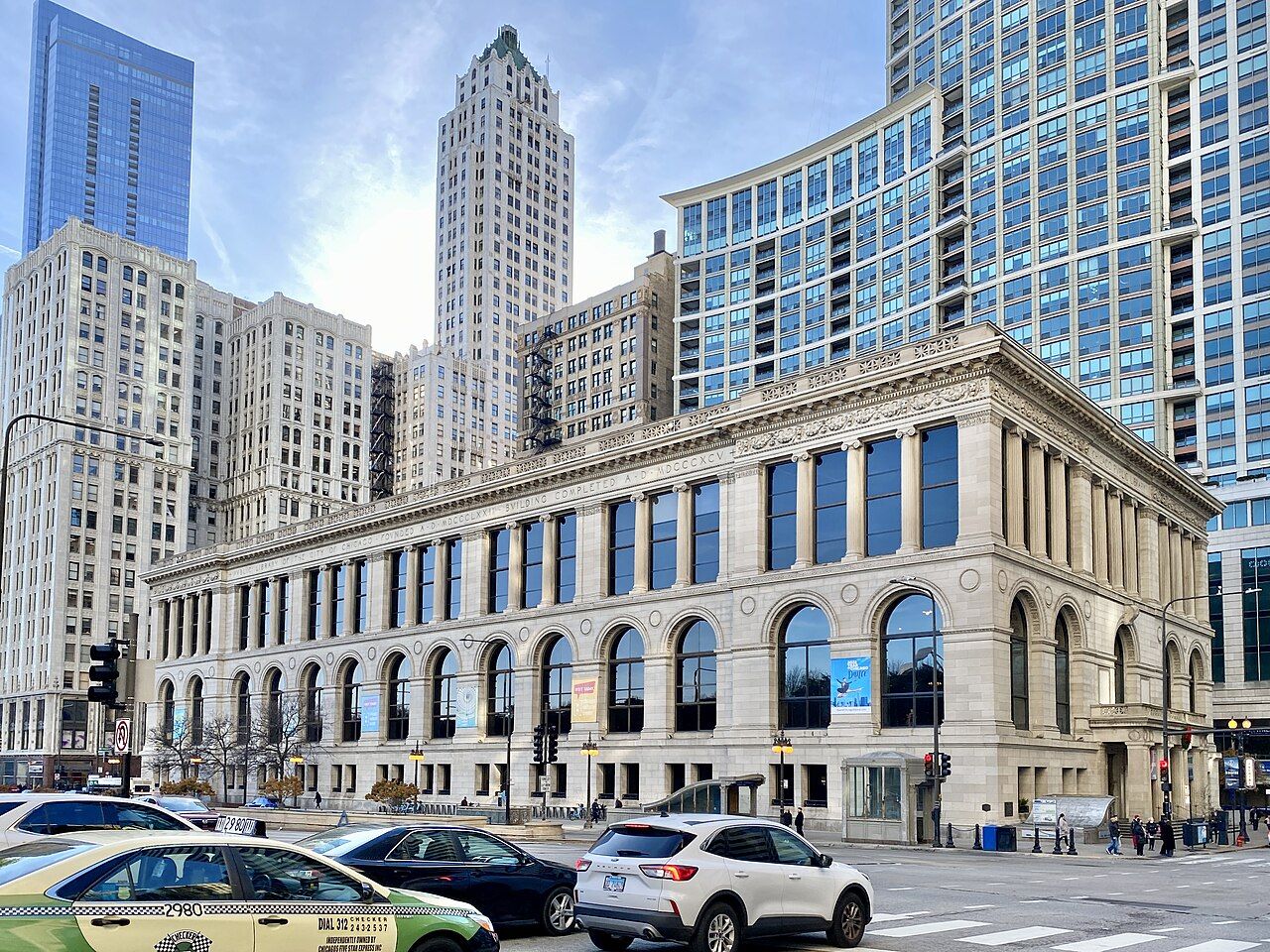
Chicago grew from a muddy trading post into one of the largest cities in the world in less than a century, and its writers grew with it. Theodore Dreiser's Sister Carrie, Upton Sinclair's novel of the stockyards, The Jungle, and Carl Sandburg's Chicago Poems all took the new city as their subject. Later came Richard Wright, Gwendolyn Brooks and Lorraine Hansberry from the South Side, and Ernest Hemingway from the suburb of Oak Park. The city also built two of the finest public library buildings in the country, a century apart, and both are free to walk into.
The old library under the dome
Chicago's public library began in the ashes of the Great Fire of 1871, when donors in Britain sent thousands of books to help the city start a free library. In 1897 the library moved into a grand Beaux-Arts building on Michigan Avenue, facing what is now Millennium Park, which it shared with a memorial hall for Union veterans of the Civil War. The library has since moved, and the building is now the Chicago Cultural Center, with free exhibitions, concerts and talks.
Climb the marble stairs, set with mosaics and the names of great writers, to Preston Bradley Hall on the third floor. Its stained-glass dome, made by Tiffany's studios, is often described as the largest Tiffany glass dome in the world. On the other side of the building, the old veterans' hall has its own glass dome. Come on a bright day, when the light through the glass is strongest, and stand directly beneath it to see the pattern of its glass scales.
Harold Washington Library Center
The main library moved in 1991 into a new building at State Street and Congress Parkway, at the south edge of the Loop. It is named for Harold Washington, the city's first Black mayor, who died in office in 1987. The building is red brick and granite, with huge arched windows and, on the roof, great green metal owls and leaf ornaments that you can see from the street.
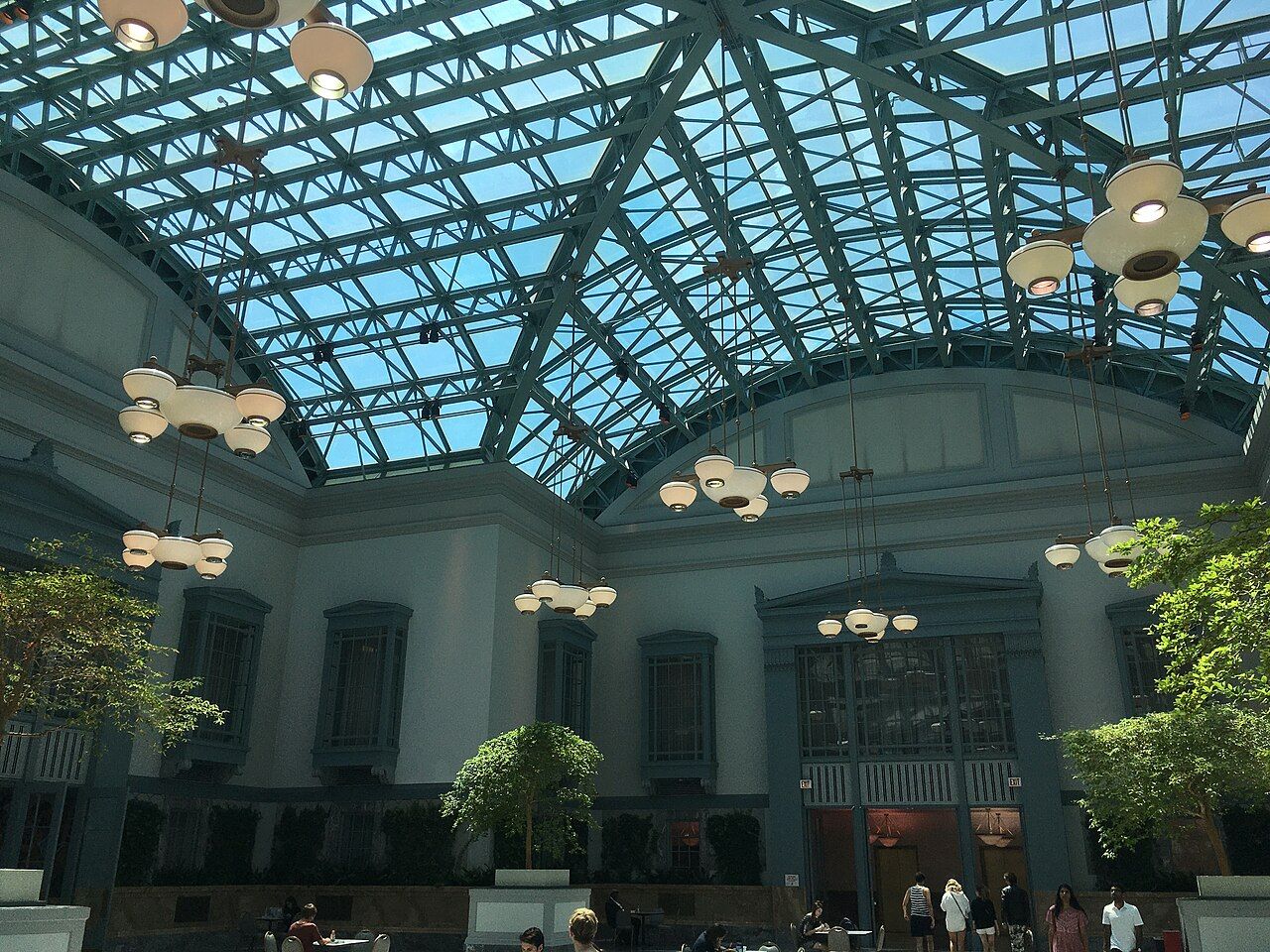
Take the lifts to the ninth floor for the Winter Garden, a tall hall under a glass roof, with trees and tables, and one of the best free places in the city to sit and read. The library's special collections, also upstairs, hold exhibitions on the city's history and writers. A few blocks north on Michigan Avenue, the American Writers Museum, a non-profit, covers the country's writers more broadly.
Shelved nearby · RD 126Books on the road: a short history of the bookmobileBronzeville and Gwendolyn Brooks
South of the Loop, Bronzeville was the heart of Black Chicago in the first half of the twentieth century. Hundreds of thousands of Black Southerners came north in the Great Migration, and housing segregation, enforced by restrictive covenants and violence, crowded them into a narrow strip of the South Side. Out of that world came a remarkable body of writing. Richard Wright, who arrived from Mississippi in 1927, set his novel Native Son here in 1940. Lorraine Hansberry, who grew up on the South Side, drew on her own family's fight against housing segregation in A Raisin in the Sun, which opened on Broadway in 1959.
Gwendolyn Brooks lived on the South Side almost all her life. Her first book, A Street in Bronzeville, appeared in 1945, and in 1950 she became the first Black writer to win the Pulitzer Prize, for Annie Allen. She was the poet laureate of Illinois from 1968 until her death in 2000. The Hall branch library on Michigan Avenue, opened in 1932 under its librarian Vivian Harsh, was a meeting place for many of these writers, and it is still a working branch library. Walk the boulevards of Bronzeville, with their greystones and churches, and read a few of Brooks's poems on the spot.
Oak Park
Ride the Green Line west to Oak Park, a leafy suburb just over the city line. Ernest Hemingway was born here on 21 July 1899, in his grandparents' Queen Anne house on Oak Park Avenue, and grew up a few streets away. The birth home is run as a museum by a non-profit foundation, restored to the way it looked in his childhood, and seen on guided tours. Oak Park is also full of houses by Frank Lloyd Wright, whose home and studio are a short walk away.
Hemingway left Oak Park after high school, became a reporter in Kansas City and an ambulance driver in Italy, and seldom came back, but his early stories carry traces of these streets and of the family summers in northern Michigan. A day here pairs well with his later house in Key West.
A day's route
Start in the morning at the Cultural Center, walk south through the Loop to the Harold Washington Library, then take the Green Line south to Bronzeville in the afternoon or west to Oak Park; you will not manage both comfortably in one day. Chicago works well as the hub of a Midwest trip: Hannibal is about five hours southwest by road. If you are touring the country's great libraries, add the Library of Congress in Washington and the main library in New York.
Pictures on loan from
- w_lemay CC BY-SA 2.0
- Cards84664 CC BY-SA 4.0