
The West · San Francisco
North Beach and the Beats, one hill at a time
In the 1950s a group of poets and novelists made a few blocks of North Beach the loudest corner of American writing. The streets are still steep, small and best seen on foot.
North Beach is a small neighbourhood squeezed between downtown San Francisco, Russian Hill and Telegraph Hill. For much of the twentieth century it was the city's Italian quarter, full of bakeries, social clubs and churches, with cheap rooms upstairs. In the 1950s those cheap rooms drew a crowd of young writers, and for a few years the neighbourhood became the West Coast centre of what came to be called the Beat Generation.
The writers most tied to the place are Allen Ginsberg, Jack Kerouac, Lawrence Ferlinghetti, Gregory Corso, Bob Kaufman and Philip Lamantia, along with older figures like Kenneth Rexroth, who acted as a host and guide to the younger poets. None of them stayed long in one apartment. What survives is the street pattern, a handful of renamed alleys, and the feeling of a district where writing and argument once spilled out onto the pavement.
The reading that started it
On 7 October 1955 a group of young poets read at the Six Gallery, a small space in another part of the city, with Rexroth introducing them. Ginsberg read the first part of "Howl" that night, and the audience, by every account, knew something had happened. Kerouac was there too, and he later turned the evening into a scene in The Dharma Bums (1958).
The next year a North Beach publisher and bookshop owner, Lawrence Ferlinghetti, brought out Howl and Other Poems in a small black-and-white paperback. In 1957 the authorities seized copies and Ferlinghetti was tried for selling obscene material. The judge ruled that the poem had social importance and acquitted him, and the case became one of the landmarks of free expression in American publishing. The bookshop at the corner of Columbus Avenue and Broadway is still there, and you will pass it as a landmark on any walk.
Jack Kerouac Alley and Columbus Avenue
Beside that corner runs a short pedestrian lane between Grant and Columbus Avenues, once called Adler Alley and now named for Kerouac. Its paving carries lines of poetry and prose set into the ground, so look down as you walk. Murals cover the walls, and the alley links the old Chinatown streets on one side with North Beach on the other.
Columbus Avenue cuts across the grid at an angle and serves as the neighbourhood's spine. Walk it north from Broadway and you pass old Italian cafés, delis and bakeries that would have looked familiar to the poets. A small museum given over to the Beats sits on Broadway nearby, with manuscripts, photographs and first editions; check its hours before you go.
Shelved nearby · WE 084Steinbeck country: from the Salinas Valley to Cannery RowThe 1950s scene was not all poetry. Black writers such as Bob Kaufman, who co-founded the magazine Beatitude in 1959, faced police harassment in the neighbourhood, and the press turned the movement into a cartoon of beards and bongo drums. Reading Kaufman alongside Ginsberg gives you a fuller picture of who was there.
Washington Square and the Italian quarter
Columbus Avenue opens onto Washington Square, a lawned park with the twin white spires of the church of Saints Peter and Paul on its north side. Locals do tai chi here in the mornings; families picnic in the afternoon. It is the obvious place to sit with a book and watch the neighbourhood go by.
The side streets around the square, such as Grant Avenue north of Columbus and the lanes off Green and Vallejo, still hold the narrow buildings and walk-up flats of the old quarter. Few of them carry plaques, and most are private homes, so enjoy them from the pavement.
Up Telegraph Hill
From the square, climb east up Filbert Street toward Telegraph Hill. The slope is steep and the reward is the summit, where Coit Tower, finished in 1933, stands in a small park. Inside the base of the tower, murals painted by local artists in the 1930s show California farm and city life during the Depression, a fitting companion to the novels of John Steinbeck's Salinas Valley.
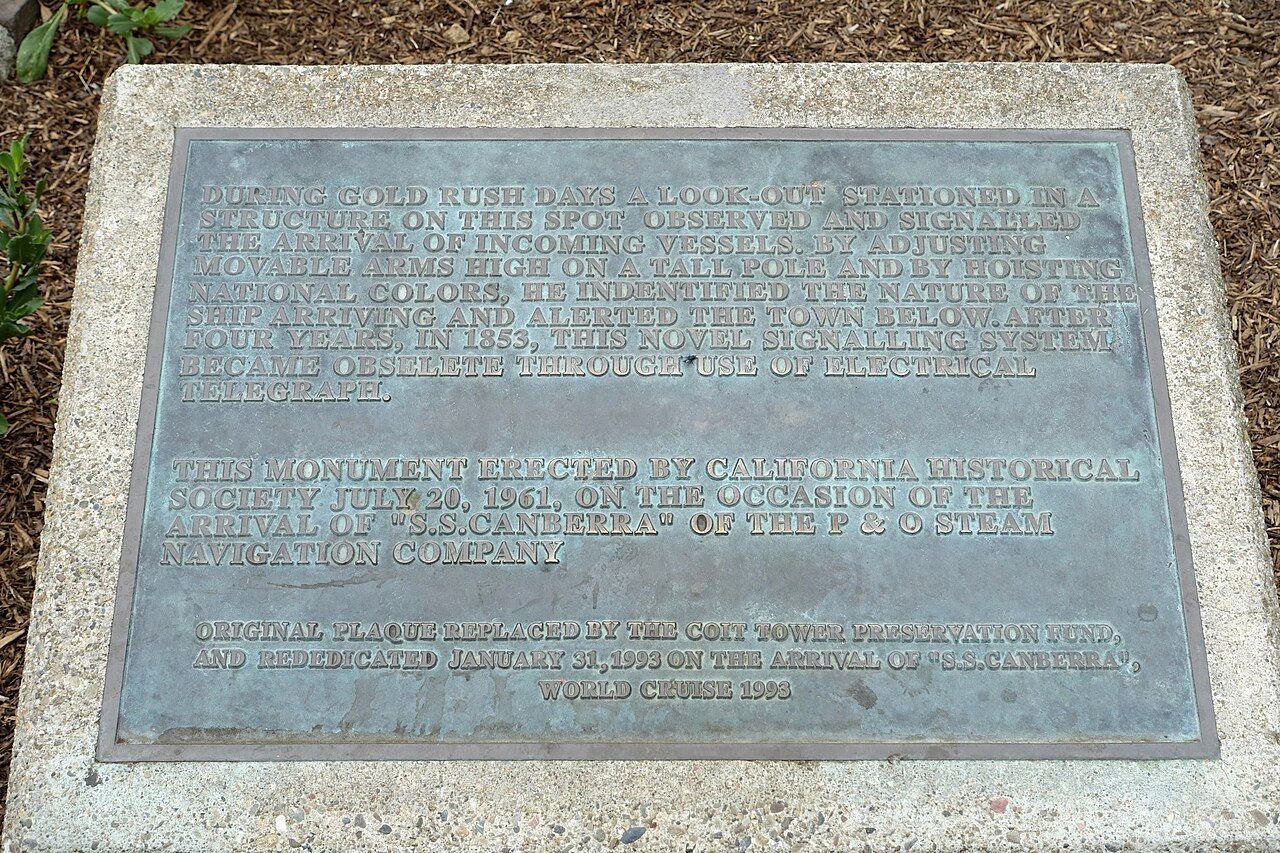
On the way up you pass a bronze plaque recalling the hill's first role. During the Gold Rush a lookout stood here and signalled the arrival of ships to the town below, until the electric telegraph made the system obsolete in the 1850s. That is how the hill got its name.
The Filbert Steps lead down the eastern face through gardens and wooden cottages toward the waterfront. They are among the pleasures of the city and they are steep, so take them slowly.
Planning your walk
- Allow half a day. Start at Columbus and Broadway, take in the alley and the avenue, rest at Washington Square, then climb the hill.
- Driving and parking in North Beach are hard. Public transport or a walk from downtown is easier.
- San Francisco summers are often cool and windy; the clearest weather usually comes in September and October.
- Coit Tower's hours and the access to its murals vary; check before you climb.
Read On the Road (1957) for the restless energy of the movement, or The Dharma Bums for its San Francisco and the mountains beyond. Then, if you are driving east afterward, compare this scene with literary New York, where Ginsberg and Kerouac first met in the 1940s.
Pictures on loan from
- Daderot Public domain
